Microscopy Hackaton 3
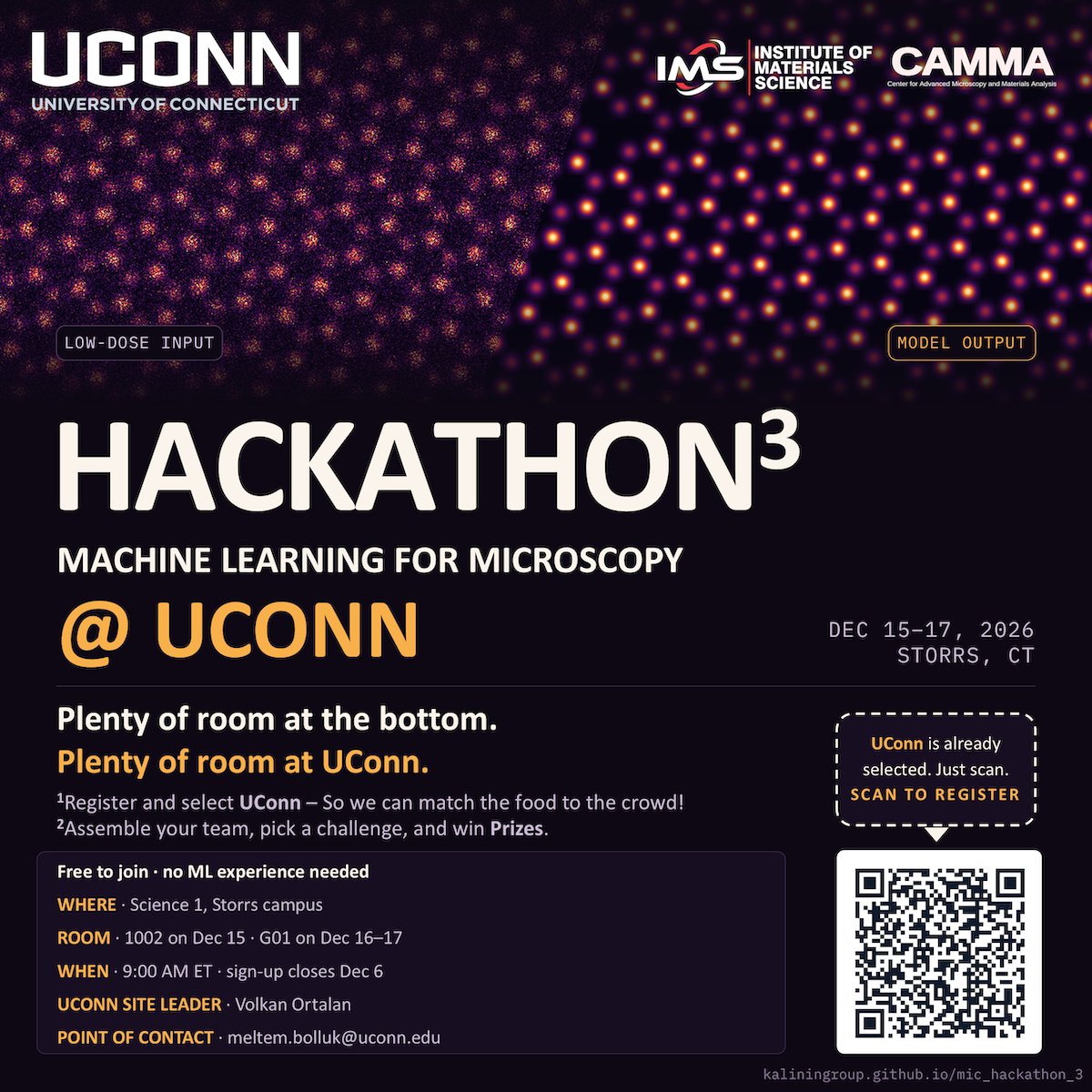
Machine Learning for Microscopy Hackathon 3 @ UConn
Real research problems. Real data. Three days to solve them.
A global hackathon at 75+ sites worldwide, and one of them is UConn.
📅 December 15–17, 2026 · 9:00 AM ET
📍 Science 1, UConn Storrs (Room 1002 on Dec 15, Room G01 on Dec 16–17)
🎟️ Free to join
📝 Register by December 6 and select UConn as your site: LINK TO REGISTER
What is it?
Think of it as a three-day research sprint. Researchers around the world propose real problems from their microscopes, together with the data. The problems are released on December 14 on a shared online board. On December 15 you join a team, pick one problem and start building. Teams work at their local site or online with people from other sites, using Google Colab, Slack and Zoom. At the end, each team shares its code, a short video and a brief write-up. A jury reviews the projects on scientific relevance, creativity and practical impact, not only on coding.
The problems cover imaging, spectroscopy, digital twins and autonomous microscopy. Examples include finding defects in atomic images, extracting physical models from images and spectra, and teaching a virtual microscope where to look next.
Why join?
• Work on problems no one has solved yet. Most courses use clean, ready-made datasets. Here the data are real and the answer is not known in advance. What you build can be a real contribution.
• Your skills travel in both directions. Denoising, segmentation, object detection and active learning are not specific to microscopy. Whether you work with medical images, biological data, chemistry or signals, you can take these methods back to your own research.
• Get hands-on with autonomous experiments. Self-driving labs and AI agents that run instruments are one of the fastest-growing areas of AI in science. Here you can steer a virtual twin of a real microscope.
• Meet the field and industry. The event is supported by companies such as JEOL, Oxford Instruments, DECTRIS and NTT DATA, with 18 sponsor awards and cash prizes up to $5,000. The organizers aim for connections that last beyond the event: collaborations, internships and hires.
• Leave with something to show. In three days you build an open project with code and a video that you can put on your CV or GitHub.
• Join a global community. You work side by side with researchers and students at more than 75 sites around the world.
How to prepare?
• Register early and join the event Slack. Teams often start forming there.
• If you are new to Python, try a short Google Colab tutorial before December 15.
• Browse the 68 projects from last year to see what a team can build in three days: PROJECTS
About the event
The ML for Microscopy Hackathon is organized worldwide by Sergei Kalinin's group at the University of Tennessee, Knoxville. The UConn site is hosted by the Institute of Materials Science (IMS), the Department of Materials Science and Engineering and CAMMA.